Executive Summary
Over the past eighteen months Neo Advisory has published sector analyses of four markets that appear, on the surface, to have nothing in common: car wash, collision repair, convenience and fuel retail, and residential home services.
They are, in fact, the same trade.
Each is a fragmented, non-discretionary, cash-generative service market with tens of thousands of independent operators and a small number of well-capitalized consolidators buying them. Each has drawn substantial private equity capital. And in each, the same arbitrage is available: a business bought as a single asset is worth materially less than the identical business inside a platform.
What differs is the size of that gap — and the reason it differs is the most useful finding in this analysis.
KEY INSIGHT Across four roll-up sectors, the platform premium ranges from roughly two turns of EBITDA in car wash to eight turns in residential home services. The premium is not a reward for scale in itself. It tracks how far a single asset already sits from being institutionally investable — which means the sectors with the widest gaps are the ones where an owner has the most value to create before selling.
An express car wash trades at 8–10x TTM EBITDA as a single site and 10–12x inside a platform — a two-turn spread. A one-truck HVAC business trades at 3–8x and contributes to a platform valued at 12–16x — a spread of roughly eight turns. Both gaps describe the same arbitrage, but they are not equally addressable, and they do not call for the same preparation.
For an owner, the practical question is not "what multiple does my sector trade at." It is "how far is my business from the thing an institutional buyer is actually trying to assemble, and how much of that distance can I close myself?"
Section 1: Why the Same Capital Targets All Four
Private equity has deployed heavily into all four sectors over the past decade, and the underwriting case is nearly identical in each.
Non-discretionary demand. Cars get dirty, get damaged, and need fuel. Furnaces fail in February. None of this defers well, and none of it moves online. In a market where roughly $1.4 trillion of global dry powder is seeking recession-resilient deployment, that quality alone commands attention.
Fragmentation at scale. Every one of these markets has tens of thousands of independent operators and no dominant player.
Cash generation without working capital drag. These are businesses that collect at point of service. There is no inventory cycle to fund and no receivables build in the retail-facing segments.
A demographic exit wave. The founder-operators who built these businesses in the 1980s and 1990s are reaching retirement without succession plans, and the trades in particular have no natural internal buyer.
Multiple arbitrage that is arithmetically reliable. This is the mechanism, and it is worth stating precisely. In collision repair, the standard sponsor model is to acquire an anchor platform at roughly 8x EBITDA, add 25–35 smaller shops at approximately 5x, and target a 10x-plus re-rating on exit — a structure underwritten to returns of 130–150% or more. Nothing about that arithmetic is sector-specific. It is the same calculation being run in all four markets.
Section 2: The Platform Premium
| Sector | Single asset | Platform | Premium |
|---|---|---|---|
| Car wash | 8–10x TTM EBITDA | 10–12x | ~2 turns |
| Collision repair | 3–5x (single shop) | 6–10x (MSO) | ~4 turns |
| Convenience & fuel | 3.5–5.5x (single store) | 9–11x | ~6 turns |
| Residential home services | 3–8x (add-on) | 12–16x | ~8 turns |
Sources: Kroll (residential HVAC), Capstone Partners (convenience), GF Data (lower-middle-market by deal size), Miracle LLC Transaction Data and Neo Advisory research (car wash, collision).
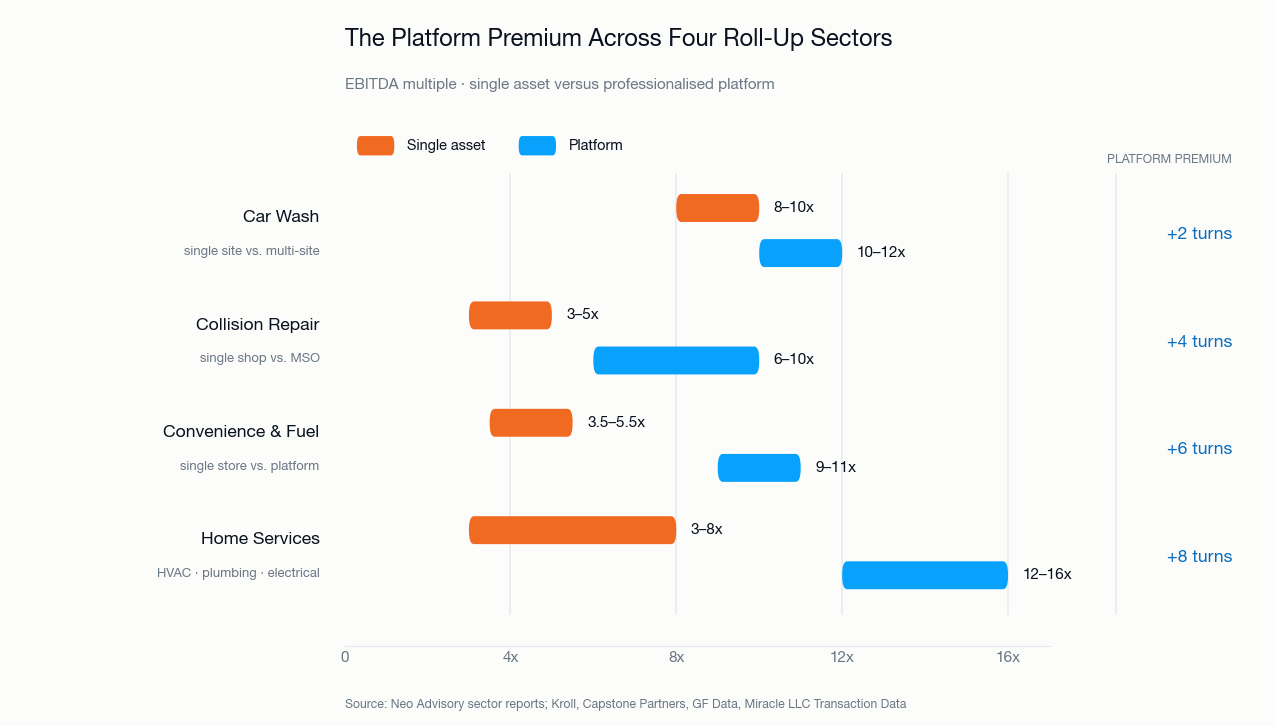
The premium is real in every sector and it is large in most of them. But the variation is what matters, and it is not random.
The premium is inversely proportional to how institutional the single asset already is.
An express car wash tunnel is, by itself, close to an institutional product. It has standardized economics, a recurring revenue base — membership runs 40–75% of revenue, and up to 80% for top-quartile operators — a defined capital cost of $5–9 million, and underlying real estate that net-lease investors will finance at 6.0–6.5% cap rates. A buyer acquiring one site is acquiring something they already understand. The remaining gap to platform pricing is narrow, because most of the professionalization is embedded in the format itself.
A single HVAC business is the opposite. Revenue is typically transactional rather than contracted. The owner is frequently the senior technician, the dispatcher and the closer. There is almost no asset — trucks and tools — so nearly all the value sits in an operating system that, in most owner-operated businesses, exists only in the owner's head. The distance from that to an institutional asset is enormous, which is exactly why the premium for closing it is enormous.
Convenience retail sits closer to the HVAC end than its asset-intensity suggests. A single store is generally valued on seller's discretionary earnings by individual buyers — it is a job with real estate attached. A multi-site platform with documented inside-store margins and a functioning foodservice program is a different asset class entirely, bought by different people.
The practical translation is direct. In car wash, an owner's leverage is mostly operational: throughput, membership retention, site quality. In home services and convenience, the leverage is structural: building the management layer, the recurring revenue and the financial presentation that move a business from owner-operated to institutionally acquirable. The second is harder, takes longer, and is worth several times more.
Section 3: What Actually Creates the Premium
Across all four sectors, the same four attributes separate a platform valuation from a single-asset one. None of them is about being large.
1. Revenue that recurs. Car wash membership at 40–75% of revenue. Home services maintenance agreements. Collision repair's direct repair program relationships with insurers. Convenience is the outlier here, which is part of why its premium sits where it does. Contracted revenue converts a business that must win each year into one that begins each year already sold, and buyers price those as different asset classes rather than the same asset with different numbers.
2. An operating system that survives the owner's departure. This is the single most common failure point. A buyer is not acquiring last year's EBITDA; they are acquiring the probability of next year's. If that probability depends on one person, the discount is severe and entirely rational.
3. Density. Route density in home services, geographic clustering in car wash and collision, regional concentration in convenience. Density drives labor utilization, marketing efficiency and management leverage, and it is why acquirers pay more for a business adjacent to their existing footprint than for a better business three states away.
4. Financial presentation a diligence team can rely on. Normalized earnings, cohort-level retention data, clean separation of owner compensation and personal expenses. This creates no economic value whatsoever and reliably moves the multiple, because it removes the uncertainty that buyers otherwise price in.
Section 4: Why the Supply of Targets Persists
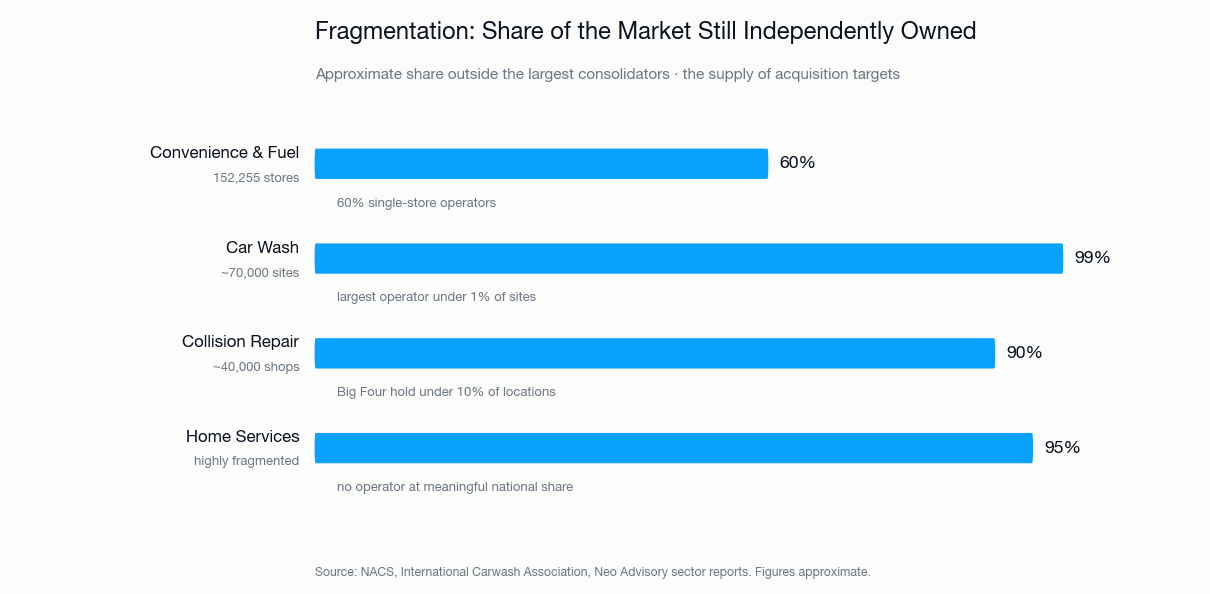
A decade of aggressive consolidation has barely dented these markets.
Roughly 60% of the 152,255 US convenience stores are single-store operators (NACS). The largest car wash operator controls under 1% of approximately 70,000 sites. In collision repair, the Big Four together operate under 10% of roughly 40,000 shops, though they command an outsized 18–22% of revenue through direct repair program leverage. Residential home services has no operator at meaningful national share at all.
The reason the supply persists is that owner-operators and institutional buyers are not making the same decision. A sponsor buys on an arithmetic case. An owner sells on a personal one — health, retirement, a partner dispute, exhaustion. Those events arrive on their own timetable regardless of where multiples sit, which is why deal flow in these sectors never stops entirely even through a downturn.
It also explains a pattern visible in all four markets: when volume contracts, it contracts among buyers, not sellers. In car wash, transaction count fell from a 2022 peak of 211 to 70 in 2024 before recovering to 82 in 2025. In convenience, sector multiples held near 10.1x through 2025 while the median transaction fell from 13 stores to eight — buyers doing more deals for fewer stores each, having exhausted the large targets and worked down-market.
Section 5: Where the Sectors Genuinely Diverge
The playbook is common. Three things are not.
Real estate separability. Car wash and convenience both sit on property that a net-lease investor will price independently — convenience at roughly 6.7% cap rates in the second half of 2025, car wash at 6.0–6.5%. That creates an arbitrage between two differently-priced buyer pools, and it is routinely left uncaptured because the business has always been held as a single entity. Home services has essentially no real estate component. Collision sits in between.
Labor as the binding constraint. In home services this is decisive. The Bureau of Labor Statistics projects average annual openings of 40,100 for HVAC mechanics, 44,000 for plumbers and 81,000 for electricians through 2034. Collision faces a comparable technician shortage. Car wash and convenience are far less exposed — express tunnel formats deliberately minimize staffing at 15–25% of revenue.
This produces a valuation argument almost no seller makes. In the labor-constrained sectors, a business that has demonstrably solved recruitment and retention owns something a buyer cannot acquire any other way and cannot build quickly. It should be presented with the same rigour as the financials, and it almost never is.
Demand direction. Collision repair is growing at roughly 3.3% toward $54.2 billion by 2030 while repairable claim volume actually falls — severity is rising faster than frequency declines. Car wash express is growing at about 4.5%. Home services is decelerating: Harvard's LIRA forecast projects $518 billion of owner-occupied improvement spending by the end of 2026 with growth easing from 2.1% mid-year to 1.6% by year-end. Convenience in-store sales grew 1.7% to $341.2 billion in 2025.
None of these is a reason to wait. When aggregate growth slows, sponsors stop underwriting expansion and start underwriting density and retention — which favors established operators, not new entrants.
Section 6: The Common Failure Mode
Every one of these sectors has produced a leveraged roll-up failure, and the mechanism is identical each time.
The reference case is Zips Car Wash. It entered Chapter 11 in February 2025 with $653.9 million of funded debt against $1 million of cash, having grown from 130 to 260 locations through 40 acquisitions in five years. It emerged on 30 April after a $279 million debt reduction, retaining roughly 230 sites (Zips).
The business was sound. $303 million of annual revenue, 625,000 members, roughly 24 million cars washed a year. What failed was the capital structure: sites acquired at peak multiples, financed on zero-rate assumptions, with an aggressive sale-leaseback program that converted flexible assets into permanent fixed rent obligations. Our founder's analysis at the time of filing put the implied average interest burden at roughly 14% in 2023 — untenable for a business dependent on consistent cash flows.
The generalization lesson is about the interaction of two things that look independent and are not. Sale-leaseback proceeds are not free capital; they are a conversion of an adjustable cost into a fixed one. Acquisition leverage is not free either. Stack them together and underwrite the combination against a base case rather than a downside case, and the business becomes fragile in exactly the way Zips did — regardless of sector.
For a seller, this matters in a way that is easy to miss. Buyer quality is part of deal quality. A headline multiple from an over-levered acquirer is worth less than a slightly lower one from a buyer who can fund, close and integrate — particularly where consideration includes an earn-out or rollover equity.
Section 7: What This Means If You Own One of These Businesses
Identify which gap you are looking at. If you own a single express car wash, you are roughly two turns from platform pricing and most of that is operational. If you own a $4 million-revenue HVAC business, you are potentially eight turns away, and nearly all of it is structural. The preparation is completely different, and so is the timeline.
Recurring revenue is the highest-return single initiative in three of the four sectors. Converting transactional customers to membership or service agreements changes what kind of asset you own, not merely how much EBITDA it produces.
Build the second layer of management before you need it. In every sector, the discount for owner-dependence is severe. It is also the slowest thing to fix, which means it has to be started first.
In car wash and convenience, decide on the real estate deliberately. Two buyer pools price the same property on different logic. Selling both together to one buyer means accepting the lower of two prices on half the asset — and separability requires clean title, no cross collateralization, and a lease a net-lease investor will underwrite. That preparation takes months and cannot be assembled once a process is live.
In the labor-constrained sectors, present workforce data as evidence. Tenure, turnover against sector norms, apprenticeship pipeline. Buyers know labor is the constraint. Almost no seller proves they have solved it.
Neo Advisory's View
What follows is our position rather than reported fact, and we have separated it deliberately so a reader can rely on the evidence above while disagreeing with the conclusion. It draws on that evidence and on direct conversations with operators and acquirers across these sectors.
1. Most owners are negotiating the wrong number.
Sale processes concentrate on the multiple. But the multiple is largely determined before the process starts, by which band the business sits in. A seller arguing for 9x instead of 8x is contesting one turn. A seller who spent eighteen months moving from add-on to platform is contesting four to eight. The negotiation matters far less than the position you enter it from, and the sequencing of effort in most sales is exactly backwards.
2. The sectors with the worst-looking single-asset multiples are the best opportunities.
A 3–5x collision shop or a 3.5–5.5x convenience store reads like a poor market. It is the opposite — it is a market where the distance between what you have and what a buyer wants is wide, and therefore where deliberate work is worth the most. Car wash owners have a narrower gap to close, which is a harder position, not an easier one: there is less available upside from professionalization because the format has already captured most of it.
3. Fragmentation is not permanent, and the exit window is not symmetric.
These markets have absorbed a decade of consolidation without materially concentrating, which makes it tempting to assume the opportunity is indefinite. It is not. Consolidators buy density first — once a sponsor has clustered a region, the strategic value of the remaining independents in that region falls, because the buyer no longer needs them. Owners in markets where a platform is actively assembling face a window that closes locally, well before it closes nationally.
4. Buyer quality deserves the scrutiny that price receives.
Zips did not fail because car washes are bad businesses. It failed because capital structure was underwritten optimistically. Sellers taking rollover equity or earn-outs are, in effect, extending credit to their buyer's balance sheet — and almost none diligence that balance sheet with the rigor the buyer applies to theirs.
5. If you intend to exit within three years, the preparation window is now.
Every one of these sectors currently has capitalized buyers, narrowed bid-ask spreads and a broadening buyer set. None of those conditions is structural. The work that moves a business between valuation bands — recurring revenue, management depth, clean financials, density — takes twelve to twenty-four months. An owner who waits for the market to peak before beginning that work will finish it into a different market.
Conclusion
Four sectors, four sets of published research, one conclusion: the money in these markets is made on the difference between what a single asset is worth and what the same asset is worth inside a platform.
Sponsors have built an industry on capturing that spread. It is legitimate — assembling a platform is genuine work that creates genuine value. But the spread is not exclusively theirs. A meaningful part of it is available to any owner willing to do the professionalization work before the sale rather than leaving it to the buyer afterwards.
That is the entire argument. The specific numbers differ by sector, and our individual reports on car wash, collision repair, convenience and fuel and residential home services set them out in detail. The structure does not.
Sources and Methodology
This analysis synthesizes Neo Advisory's four published sector reports and the underlying data behind them. Multiple ranges are drawn from the sources cited below; where we have characterized a premium as a number of turns, it is the midpoint difference between the stated single-asset and platform ranges, and is an approximation rather than a transaction-weighted average.
Neo Advisory sector reports
- 2026 Car Wash Sector Market Overview
- 2026 Collision & Repair Sector Market Overview
- 2026 Gas Station and Convenience Store Sector Market Overview
- 2026 Residential Home Services Sector Market Overview
Third-party sources
- Kroll — M&A in residential HVAC services: add-on and platform multiple ranges.
- Capstone Partners — Convenience Store Acquisitions Update: sector transaction multiples, median deal size, single-store operator share.
- GF Data — Small-deal resilience, H1 2025: lower-middle-market multiples by transaction size.
- NACS — U.S. convenience in-store sales: store counts, sales, gross profit composition.
- Harvard Joint Center for Housing Studies — Leading Indicator of Remodeling Activity: home improvement spending forecast.
- U.S. Bureau of Labor Statistics — HVAC mechanics, plumbers, electricians: projected annual openings.
- Zips Car Wash — Chapter 11 restructuring: debt quantum and restructuring terms.
- FOCUS Investment Banking — Washing Away Debt: Zips Car Wash and the Cost of Private Equity Ambition: our founder's April 2025 analysis.
- Transaction counts: Miracle, LLC Transaction Data.
- Charts prepared by Neo Advisory from the data cited in each figure.
Prepared by John-Michael Tamburro, Founder, Neo Advisory.
This report is prepared for informational and publication purposes only. It does not constitute investment or financial advice. All figures are estimates and subject to revision, and forward-looking projections are inherently uncertain.