Executive Summary
Owners of lower-middle-market businesses are being told, from every direction, that they need an AI strategy. Much of that advice comes from people who will never have to value the resulting business.
We sit on both sides of that question. Neo Advisory implements AI systems for founder-led companies, and Neo Advisory advises those same companies when they sell. So the question we get asked most often — will this show up in my valuation? — is one we are unusually placed to answer, and the honest answer is narrower than the marketing suggests.
AI investment affects enterprise value only where it reaches the income statement. Not where it appears in a pitch deck, not where a license appears in the expense ledger, and not where a pilot is described as "underway." Buyers underwrite earnings and the durability of earnings. An AI initiative that has not moved either is, to an acquirer, a cost line with a story attached.
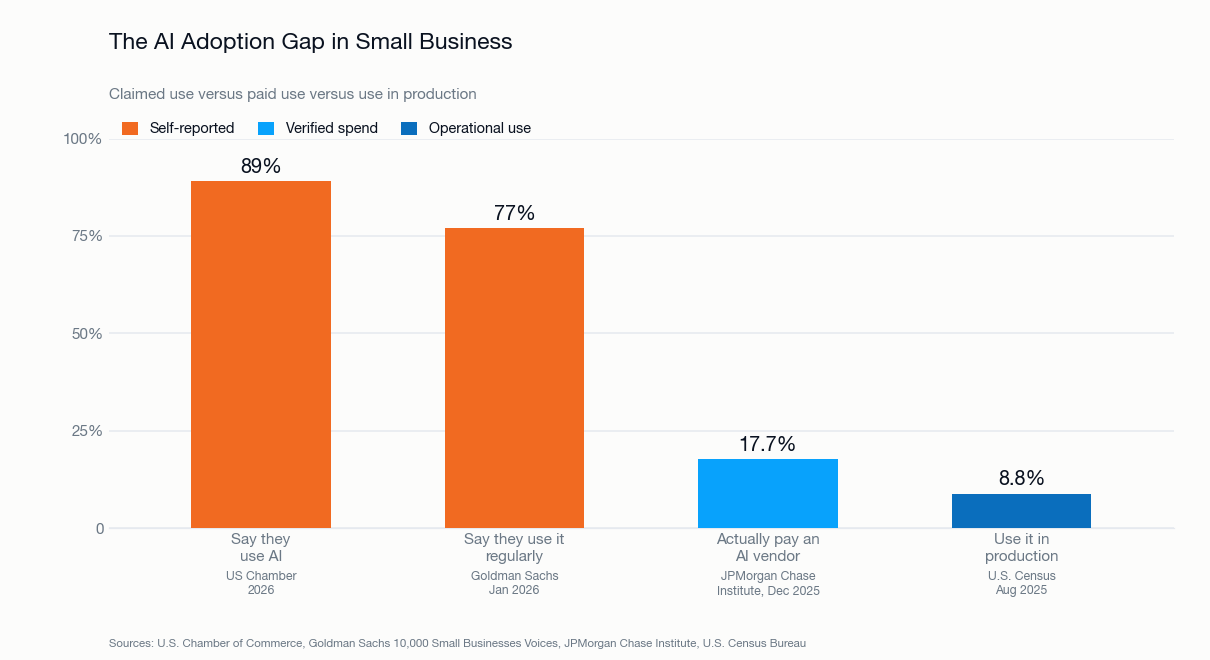
KEY INSIGHT In 2026, 89% of U.S. small businesses reported using AI in some capacity. Only 17.7% were actually paying an AI vendor, and just 8.8% reported using it in the production of goods or services. That gap — roughly ten to one between claimed use and operational use — is precisely the gap acquirers have learned to price. Buyers do not pay for the 89%. They pay for the 8.8%.
This is not a reason to avoid AI investment. It is a reason to be precise about which investments a buyer will underwrite, and to structure the work so that the evidence exists when the diligence request arrives.
Section 1: The Adoption Gap Is Real, and It Is Enormous
The headline statistics on small-business AI adoption are close to useless, because they measure entirely different things.
| Measure | Figure | Source | What it counts |
|---|---|---|---|
| Say they use AI in some capacity | 89% | U.S. Chamber of Commerce, 2026 | Any use, self-reported |
| Say they use AI regularly | 77% | Goldman Sachs 10,000 Small Businesses Voices, Jan 2026 | Regular use, self-reported |
| Pay for AI services | 17.7% | JPMorgan Chase Institute, Dec 2025 | Verified payments across 4.6m business accounts |
| Use AI in production of goods or services | 8.8% | U.S. Census Bureau, Aug 2025 | Operational deployment |
The JPMorgan figure deserves particular attention because of how it is derived. It is not a survey. It analyses actual paid transactions across 4.6 million Chase Business Banking accounts — it requires a business to have written a cheque to an AI vendor. That is a materially harder test than answering yes to a questionnaire, and the result is roughly one-fifth of the self-reported number.
The Census figure is harder still: 8.8% of businesses under 250 employees reported using AI in the production of goods or services, up from 6.3% six months earlier.
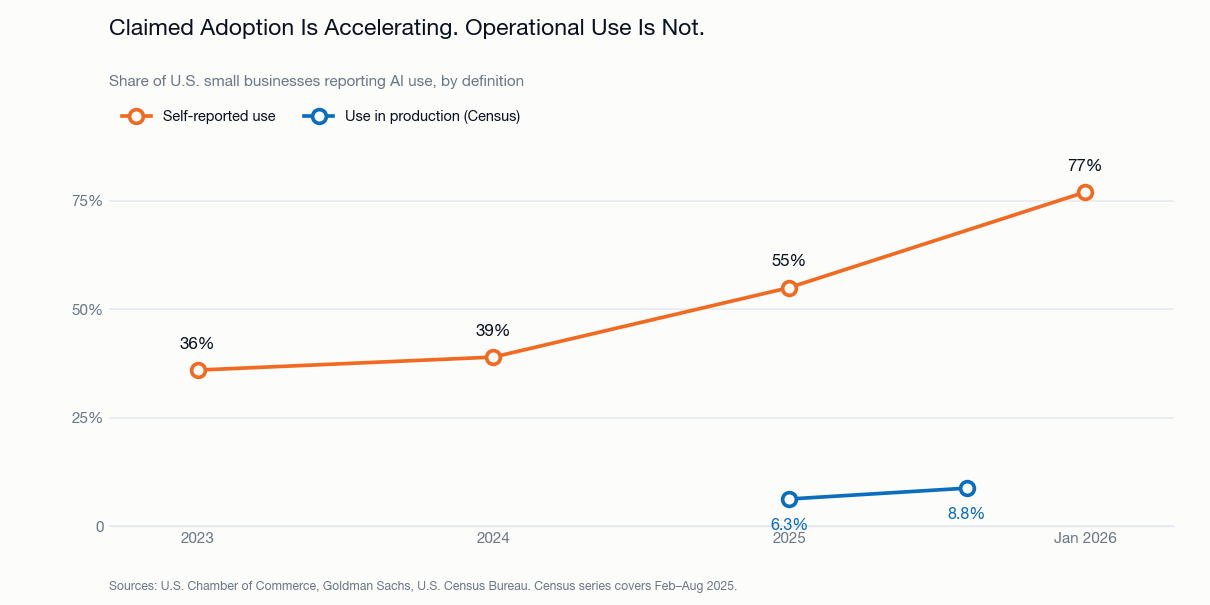
Both things are true simultaneously. Adoption is genuinely accelerating — this is among the fastest technology adoption curves ever recorded in small business, faster than smartphones or broadband. And the overwhelming majority of that adoption has not yet reached operations.
For an owner, the strategic implication is uncomfortable but useful: being in the 89% is worth nothing at exit, because your buyer assumes it. Being in the 8.8%, with evidence, is a differentiator precisely because it is rare.
Section 2: What Buyers Are Actually Doing With AI
Before addressing what buyers pay for, it is worth understanding that the buyers themselves have adopted faster than the businesses they acquire.
Nearly half of dealmakers now use AI tools almost daily, and diligence is where it has paid off first — purpose-built platforms read entire data rooms and answer specific questions with cited sources, compressing weeks of associate time into days (FTI Consulting).
This matters more than it appears. In the lower middle market, technology diligence has historically been thin. In sub-$100 million deals, technology assessment often falls to a former CTO parachuted in days before close with a two-week window and a checklist (ACG). AI-assisted diligence is closing that gap. The practical consequence is that claims which previously went unexamined are now checked — cheaply, quickly, and against the underlying data rather than the narrative.
A second shift matters for sellers. M&A rose from the lowest-ranked value-creation lever in 2025 to the top priority for private equity firms in 2026 (FTI Consulting). Buyers are more acquisitive and better equipped to test what they are buying.
Section 3: What Buyers Pay For — and What They Do Not
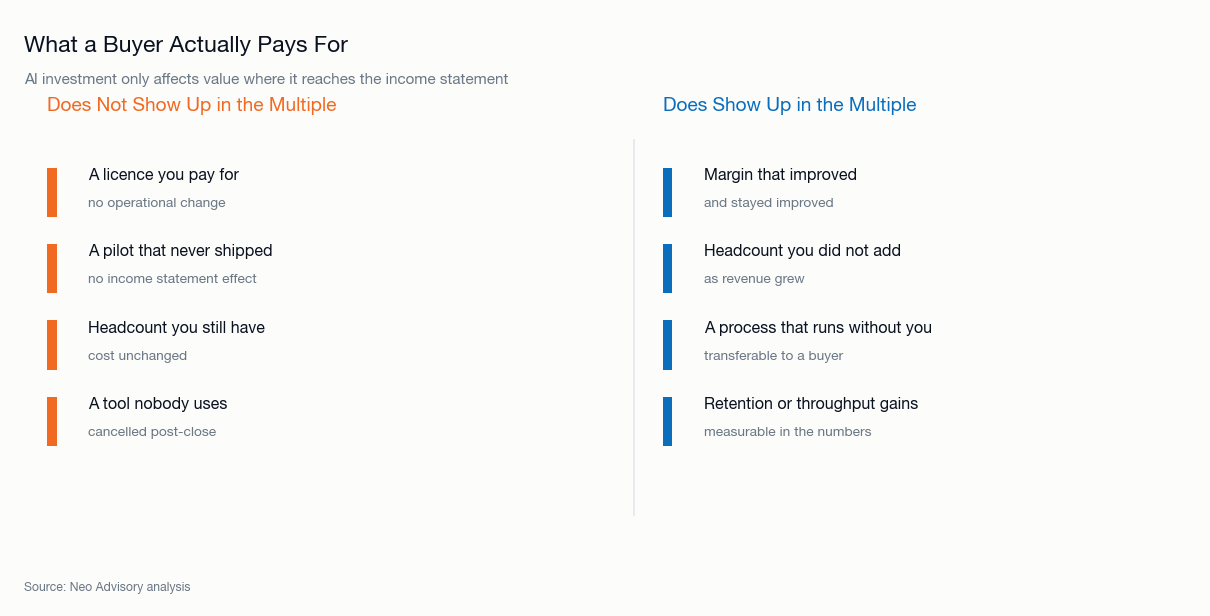
The distinction is not subtle, and it is the same distinction private equity applies to its own portfolio. Companies embedding AI into operations must show measurable income statement impact before commanding premiums — the premium is not automatic (CLA).
Three tests determine whether an AI investment survives diligence.
Did it change a number, and did the number stay changed? A margin improvement that appeared for one quarter and reverted is not an improvement; it is noise. Buyers look for a step-change that persists across at least a full cycle — which is why work started twelve months before a sale is worth more than work started three months before.
Does it work without the person who built it? This is the failure point we see most often. An owner who has personally configured an AI workflow has created a dependency, not an asset. If the system needs its author to operate, a buyer discounts it exactly as they discount any other owner-dependence.
Can you evidence it? Before-and-after operating metrics, dated. Headcount that was not added as revenue grew. Cycle time that fell. Without evidence, the claim is unverifiable, and unverifiable claims are worth zero in a data room — sometimes less than zero, because they invite scrutiny of everything adjacent.
The high-performer gap
There is a striking data point in the private equity research. High performers are not adopting AI at materially higher rates than everyone else. But 19% of them report exceeding their AI business case, against 5% of others (FTI Consulting).
The differentiator is not adoption. It is deliberate application to a specific value-creation lever. That finding maps directly onto what we see in lower-middle-market businesses: the operators getting returns are not the ones who bought the most tools. They are the ones who picked one expensive, repetitive, well-defined process and removed it.
Section 4: Where AI Actually Moves the Number in Our Sectors
Generic AI advice fails in the lower middle market because it is written for businesses with IT functions. Here is where we see genuine income-statement effect in the sectors we cover.
| Sector | Where AI reaches the income statement | Why a buyer credits it |
|---|---|---|
| Multi-site car wash | Membership churn prediction and targeted retention | Churn between 6% and 8% is the difference between valuation bands; retention is directly modeled in diligence |
| Residential home services | Dispatch and routing optimization; call scoring | Technician capacity is the binding constraint on growth; more jobs per truck is margin |
| Convenience and fuel | Foodservice demand forecasting and labour scheduling | Foodservice carries the margin; waste and overtime are the two controllable leaks |
| Collision repair | Estimate review and parts procurement | Cycle time and parts margin are the two levers insurers do not control |
The pattern in every case is the same. The valuable applications are narrow, operational and measurable. The applications that do not survive diligence are broad, strategic and described in future tense.
Section 5: The Honest Risk — AI Is Also Repricing Businesses Downward
It would be one-sided to present AI purely as a value opportunity. In some sectors it is doing the opposite.
Technology deal value fell roughly 70% from Q4 2025 to Q1 2026, as anxiety about how AI will reprice software clouded valuations across the sector (FTI Consulting). Buyers became unwilling to underwrite recurring revenue that AI might commoditize.
The businesses we advise are largely insulated from this. A car wash tunnel, a collision shop and an HVAC route are physical, local and non-substitutable by software. That insulation is itself worth something in the current market, and it is under-argued by sellers who assume buyers only reward technology exposure.
But the reasoning generalizes. If a meaningful share of your earnings comes from work AI could plausibly perform — routine back-office processing, basic customer support, standardized documentation — a sophisticated buyer will model that erosion. The right response is to automate it yourself and bank the margin, rather than wait for the buyer to price the risk on your behalf.
Neo Advisory's View
What follows is our position rather than reported fact, and we have separated it deliberately. It draws on the evidence above, on our own implementation work, and on direct conversations with operators and acquirers.
1. The honest answer to "does AI increase my valuation" is: not directly, and that is the wrong question.
AI is not a valuation input. Earnings are, and the durability and transferability of those earnings are. AI is one route to changing them. Asking whether AI raises your multiple is like asking whether a new till system does — it depends entirely on whether it changed the numbers a buyer underwrites. Owners who chase the multiple directly buy tools. Owners who chase the earnings buy outcomes, and get the multiple as a consequence.
2. The adoption gap is a genuine opportunity, and it is closing.
With 89% claiming use and 8.8% operating in production, an owner who is credibly in the smaller group has a differentiator today. That will not last. Adoption is compounding quickly, and within two or three years operational AI will be table stakes rather than a distinguishing feature — at which point its absence becomes a discount rather than its presence a premium. The asymmetry favors acting now, and it decays.
3. Do not start an AI program inside twelve months of a sale.
This is the most practical thing in this article. Implementation is disruptive: processes change, staff resist, the first attempt usually fails. Doing that during a sale process introduces operational noise into exactly the period a buyer is examining, and produces no track record to point at. If you are selling in under a year, finish what you have started and document it. Start nothing new.
4. The buyer will ask a question most sellers cannot answer.
"What happens to this if the person who set it up leaves?" In our experience the honest answer is usually "it stops," and sellers rarely have a better one prepared. Documentation, a named internal owner other than the founder, and a written process are what convert an AI deployment from a personal capability into a transferable asset. That work is unglamorous and it is the whole difference.
5. Being un-disruptable is a claim worth making explicitly.
Buyers are actively discounting businesses whose earnings AI might erode. If yours are physically delivered and locally protected, say so, and say it with the same specificity you would apply to a financial claim. It is a genuine element of earnings durability in 2026, and almost nobody is presenting it.
Conclusion
The gap between 89% and 8.8% is the whole answer to the question in the title.
Buyers have learned to distinguish the two, and AI-assisted diligence now makes that distinction cheap to test. An owner who has bought licenses and run pilots has an expense line. An owner who has removed a cost, avoided a hire, or improved retention — and can evidence it across more than a quarter, without personally operating the system — has changed the earnings a buyer is underwriting.
Only the second one is worth anything at exit. It is also, not coincidentally, the only one worth anything while you still own the business.
Sources and Methodology
Adoption figures are drawn from the four cited sources, which measure materially different things; we have labelled each rather than reconciling them, because the divergence is the point. Sector applications reflect Neo Advisory's implementation work and our published sector research. Where we express a view rather than report a finding, it is contained in the Neo Advisory's View section and marked as such.
- U.S. Chamber of Commerce (2026) and Goldman Sachs 10,000 Small Businesses Voices (Jan 2026), via Booth Associates and QuickSEO summary of survey data: self-reported adoption.
- JPMorgan Chase Institute — Understanding the use of AI among small businesses: paid AI adoption derived from 4.6 million business banking accounts, and U.S. Census Bureau production-use data.
- FTI Consulting — Four predictions for private equity in 2026 and AI speeds up returns in private equity: diligence adoption, the high-performer differential, technology deal value.
- CLA — AI and private equity in 2026: the requirement for measurable income statement impact before a premium.
- ACG — Closing the technology diligence gap in the lower middle market and AI tackles the lower middle market's QoE data problem: diligence practice in sub-$100m transactions.
Related Neo Advisory research
- 2026 Car Wash Sector Market Overview
- 2026 Residential Home Services Sector Market Overview
- 2026 Gas Station and Convenience Store Sector Market Overview
- Four Roll-Up Sectors, One Playbook
Charts prepared by Neo Advisory from the data cited in each figure.
Prepared by John-Michael Tamburro, Founder, Neo Advisory.
This article is prepared for informational and publication purposes only. It does not constitute investment, financial or tax advice. All figures are estimates and subject to revision.